
Golf Carts

Batteries power golf carts and personal vehicles that have become essential transportation across golf courses, retirement communities, resorts, industrial facilities, and more. As these versatile vehicles expand into new applications and serve increasingly diverse needs, reliable battery technology has never been more critical to their performance.

Battery-Powered Golf Carts: Evolving Emission-Free Applications

Golf carts have evolved from simple course vehicles into versatile transportation solutions serving diverse communities and a variety of applications. And as their uses have changed, so too has the underlying technology powering these vehicles. Carbon reduction, performance and cost considerations have resulted in a long-term shift away from combustion engines and towards battery power.

A dramatic market shift away from golf courses and towards many forms of low-speed transportation is driving the latest battery developments, as newer personal vehicles require more power and benefit from longer range across more applications.


Golf Cart

Beyond the Golf Course

Golf carts emerged in the 1950s with a simple and obvious purpose. Early models were utilitarian, and primarily gas-powered as they followed the automotive technology of the era.

By the 1980s, golf carts had moved into other areas of life as these compact, low-speed vehicles were used in new ways for short-distance transportation. That included retirement communities, tourist resorts, and large industrial properties, among other areas.

Today, the global golf carts market continues to expand and is more accurately described as a personal vehicles market.

It includes roughly 300,000 vehicles sold annually in the U.S. and a global fleet that tops 6 million by some estimates. What’s more, only about one third of these vehicles are used on golf courses as the rest are used for transportation in other ways.

Golf Cart

A Battery Powered Revolution

Of the current worldwide fleet, electric golf carts represent nearly 72 percent of total usage – far outpacing combustion engine market share. This is because of several concerns, including:

Emissions – Battery-powered carts produce zero CO2 emissions during operation.

Noise – Vehicles powered by batteries can be nearly silent while running.

Engine Maintenance – Gas engines require upkeep such as oil changes, air filters, and spark plugs.

Fuel costsElectric power costs significantly less per mile than gasoline.

Lithium vs. Lead Battery Golf Carts

This evolution of the personal vehicle marketplace reflects broader technological trends in transportation, as customers have more choices than ever before. In fact, even among battery-powered golf carts there is an array of options – chief among them being what kind of battery chemistry to use.

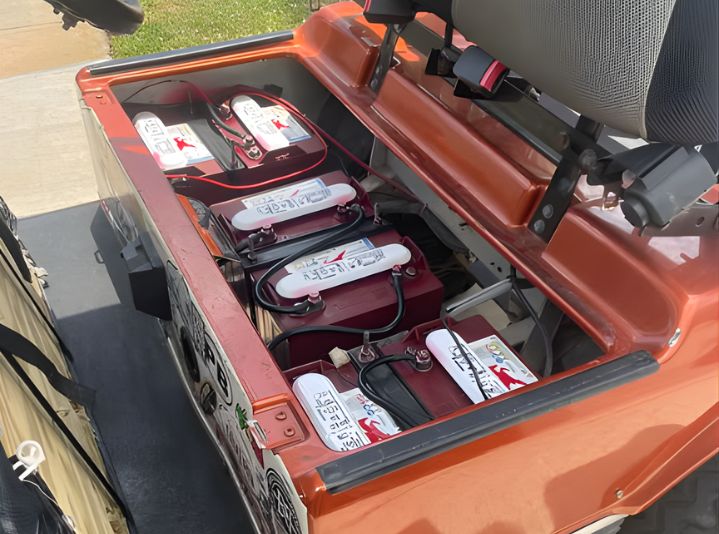
Lead batteries are the oldest and most-proven solution for many applications. This legacy  battery chemistry has been the foundation of electric vehicles for over a century and represents a mature, well-understood and reliable technology. There are many reasons as lead batteries have been so successful for so long, including:

  • Lower initial costs vs. alternatives like lithium-ion batteries
  • Established domestic supply chains
  • A circular economy, powered by a 99% recycling rate

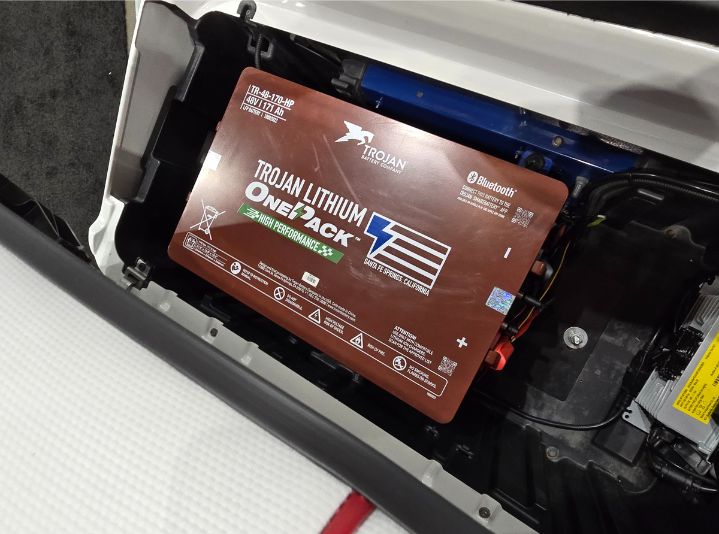
More modern lithium-ion battery technology provides additional features, but with some trade offs. Lithium batteries have a higher energy density than lead batteries, allowing for bigger spikes in power output to power performance-driven applications as well as a smaller physical footprint. Some advantages to this newer battery chemistry includes:

  • Higher discharge rates to power energy-intensive applications
  • Faster recharging times
  • Smaller weight and volume requirements
Golf Cart

Choosing the Best Golf Cart Battery

Lead battery innovation including Absorbed Glass Mat (AGM) and Gelled Electrolyte Valve-Regulate technologies have helped this legacy energy storage solution keep up with some more modern alternatives but as with any product, the best battery to power your golf cart fleet depends on your specific use case.

If you care about the environment: While any battery battery-powered vehicle provides lower emissions than a combustion engine, lead batteries edge out lithium batteries when it comes to sustainability. Lead batteries are the most-recycled consumer product, with a recycling rate of 99% in the U.S.  Lithium batteries are recycled at only a 20% rate.

If you can’t afford downtime: Lead batteries charge more slowly, so fleets that require 24-hour operation or constant use may be better served by lithium golf carts. However, lead batteries will achieve a full charge during overnight hours or even on long lunch breaks if your operations allow for more flexibility.

If you care about up-front costs: Lead batteries are generally cheaper to buy up front, providing access to more affordable golf cart fleets. Lithium undoubtedly has advantages in certain use-cases, but those advantages frequently come at a higher price. Calculating the total cost of ownership over the lifetime of a golf cart is an important step to selecting the right battery chemistry.

If you care about performance: Lithium-ion batteries have a higher energy density than lead. Therefore, aligning the battery solution with your performance needs along with maintenance and other requirements is important. For personal vehicles that require extensive periods of high performance or complex auxiliary systems, lithium may make more sense. But for fleets looking for simple, short-range transportation solutions, lead batteries are more than capable.

Golf Cart

Talk to Your Trusted Supplier

Battery-powered golf carts are more common than combustion-engine alternatives for many obvious reasons. But choosing which battery technology is right for your fleet is not quite as simple.

Some fleet operators aren’t interested in lithium-ion batteries because their needs can easily be met by proven lead batteries at a lower cost. However, others may find lithium-ion golf carts are a better choice thanks to the charging or performance benefits that come from a higher energy density.

BCI urges fleet operators to work with a reputable BCI-member battery provider, distributor, or dealer to analyze your facility operations before selecting a power source.

Furthermore, BCI reminds all fleet operators to consider local codes and restrictions in any fleet choice – including those applicable to charging infrastructure. Certain jurisdictions may be more challenging than others when it comes to electrical service for power-hungry lithium charging stations, fire code and safety requirements, and other concerns that should be part of any decision on your fleet needs.

What’s Next for Battery Golf Carts?

The next generation of battery technology promises to further improve golf cart performance and economics. Solid-state batteries, which replace liquid electrolytes with solid materials, are approaching commercial viability. Battery management systems are also becoming increasingly sophisticated, incorporating artificial intelligence and machine learning to optimize charging patterns.

Modular and swappable battery designs also provide a great platform for growth and improvement. If depleted battery packs can be quickly swapped for charged units, eliminating charging downtime entirely and simply requiring more batteries for a fleet instead of more overall vehicles.

And of course, the digital revolution continues to push the boundaries of what we define as a “golf cart.” Newer models blur the line between golf carts and low-speed vehicles, with some reaching speeds of 35-40 mph while maintaining street-legal low-speed vehicle status.  Modern battery-powered personal vehicles can include up to eight seats, Wi-Fi and GPS connectivity, entertainment consoles, and much more. Beyond creature comforts, there are also facility management concerns such as sensors to monitor battery health and brake wear along with telematics to optimize routes and performance. In short, the features of tomorrow’s golf carts are limited only by the imagination of manufacturers and customers.

Golf Cart
John Howes

The Energy Storage Grand Challenge report….reflects growing recognition from DOE and others that lead batteries are among important energy storage technologies that require investment to secure America’s global leadership on technological innovation and a green economy infrastructure.

John Howes, Principal, Redland Energy Group