
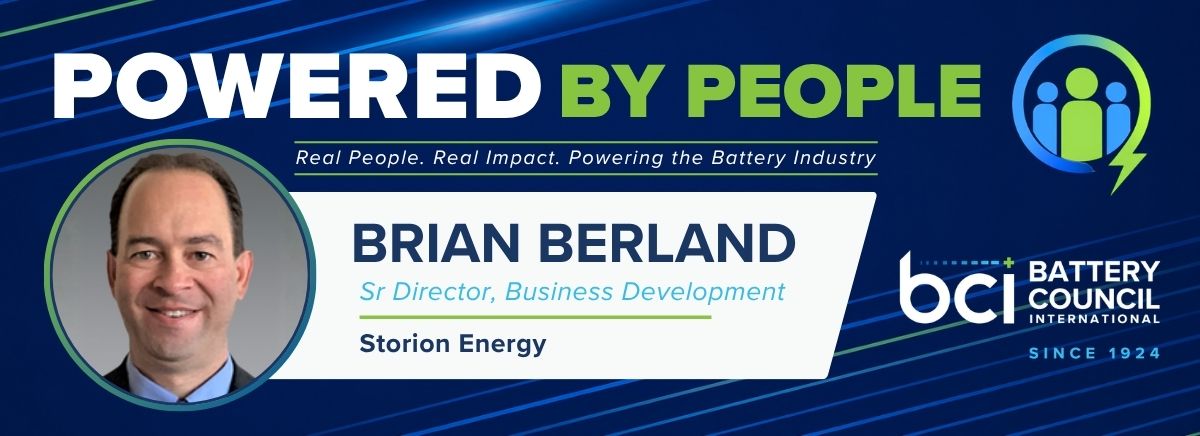
Powered by People is a series that highlights the essential workers who support battery manufacturing, recycling, innovation, and logistics. These dedicated employees are the true strength of the battery industry. They protect critical mineral supply chains, develop new technologies, and build the resilient energy storage industry that will power tomorrow’s economy.
When most people picture grid-scale energy storage, they picture a familiar lead battery or a rack of lithium-ion cells. Brian Berland has spent the last 25 years thinking bigger — quite literally. The batteries he works on hold their energy in tanks of liquid electrolyte, arrive in units roughly the size of shipping containers, and are built to run for eight, ten, or twelve hours at a stretch.
The grid is starting to ask for exactly that. Data centers, electrification, and a wave of new domestic manufacturing are pushing U.S. electricity demand higher than it has been in decades, and more of the supply meeting that demand is variable. Since 2010, battery energy storage systems have become central to keeping the grid stable, with lithium-ion dominating deployments. But storing power for minutes or a couple of hours is a different job from carrying an evening peak, and that gap is what has utilities, developers, and financiers taking a serious look at long-duration energy storage.
Berland, who holds a Ph.D. in chemistry from the University of Colorado, has spent a quarter century on hard energy problems: harvesting solar energy without silicon semiconductors, portable fuel cells, flexible electrochromic window films that improve a building’s energy efficiency, and batteries as thin as a sheet of paper for medical devices and flexible electronics. Since 2010, his focus has been vanadium redox flow batteries (VRFBs), which store their energy in a liquid electrolyte that flows through a stack assembly to deliver power. Because the tanks and the stacks are sized independently, adding hours of storage mostly means adding electrolyte — which is why the technology scales so naturally into long-duration applications.

“Many people in the general public are still unfamiliar with flow batteries. But once I share with them how this unique technology works, and what applications flow batteries are best suited for, they’re always eager to learn more,” Berland said. “It was like that for me, too, when I first started in the field. I was hooked on flow batteries. I knew this was a technology that had amazing potential, and I knew I wanted to make sure that potential was realized.”
That conviction has shaped the arc of his career. Berland started in materials science and component design, moved into grid-tied demonstration projects, and then into commercialization strategy. Today he’s Senior Director of Business Development at Storion Energy, a company built around a deceptively simple idea: if flow batteries are going to be the next big thing in grid-scale storage, someone has to build a resilient North American supply chain to support that future growth.
“I’ve spent my early career on the technical side of this industry, but over the last several years, the challenges have shifted from perfecting the technology to establishing a mature commercial infrastructure to let this technology compete,” Berland said. “At Storion, we realized there was a major gap in the marketplace — a robust supply chain of components, especially making the vanadium electrolyte readily available at a price and scale to meet the rapidly growing demands.”
A Proven Technology Meets Its Moment
Flow batteries are not a new idea. Vanadium chemistry has been studied for roughly half a century and running in commercial installations for about twenty years — long enough to build a real operating record in the field. That record matters to the utilities and financiers who have to underwrite a twenty-year asset, and it is a large part of why flow batteries are moving out of demonstration projects and into procurement. What changed is not the technology but the ask.
And that ask is now everywhere. A solar farm can shift midday generation into the evening peak instead of curtailing it. A data center campus can firm its own supply and ride through an outage rather than leaning on the grid. A utility can defer a transmission or substation upgrade by siting storage where the constraint is. An industrial site can shave demand charges and buy power when it is cheapest. What those uses share is a battery that cycles hard, every day, for as long as the asset lives.
“Lithium-ion and lead batteries are both fantastic at what they do. And they aren’t going anywhere,” Berland said. “But if you need eight, ten, twelve hours of storage, you’re asking a technology to do something it wasn’t really built for. Flow batteries are built for exactly that job.”
That distinction matters to an industry now working around real constraints on critical battery materials. Lead, lithium, sodium, and flow batteries all bring different strengths, and all of them will be needed to meet the complex and growing needs of an energy-hungry world.
Building a Foundation for the Future of Flow Batteries
Storion Energy — a joint venture formed in 2025 between an affiliate of Stryten Energy and Largo Clean Energy — was created to tackle a problem that had quietly slowed VRFB adoption for years: cost and access to vanadium electrolyte, which typically makes up a large share of a flow battery system’s total price tag. Storion pairs a domestic, vertically integrated supply chain with a novel leasing model for vanadium electrolyte, an approach designed to lower the up-front capital costs that have historically made flow batteries a harder sell than lithium-ion, even when the long-duration economics favor them.
Berland has also been a fixture in the industry’s efforts to professionalize and standardize the technology as it scales. He serves on Battery Council International’s Flow Battery Industry Group and supports programming for Flow Batteries North America (FBNA) — the only event in North America dedicated exclusively to flow battery technology and grid-enabled energy storage. This year’s FBNA conference takes place October 19-22 in Phoenix, Ariz., and will welcome some 200 industry professionals who are building the future of flow battery technology. For a technology that spent years explaining itself one conversation at a time, a single room holding developers, suppliers, utilities, and policymakers is its own kind of infrastructure.
Berland contributes to the International Electrotechnical Commission’s working group on vanadium flow battery standards, and serves as an industry lead on supply chain and manufacturing efficiency for the Long Duration Energy Storage National Consortium. Setting standards, documenting performance, and strengthening supply chains rarely makes headlines, but it is the work that gives customers, utilities, financiers, and policymakers confidence that an industry can deliver at scale.
“The work of BCI’s Flow Battery Industry Group and other similar bodies isn’t always glamorous, but it’s exactly what a growing technology needs. If we want utilities and policymakers to trust flow batteries the way they trust lead-acid or lithium-ion, the industry has to earn that confidence — through consistent messaging and well-documented performance, not just one person’s sales pitch,” Berland said.
Though flow batteries are still a relatively unfamiliar technology to many policymakers, Berland’s own career illustrates how quickly the field has caught on. He began as a researcher in labs and pilot projects, then moved into a commercial role as demand for long-duration storage accelerated real-world installations. That demand is only set to grow. As data centers, utilities, and grid operators scale up, they need proven, cost-effective storage to power the next phase of AI.
He has watched that case get made in the field. At a remote farming site in southern Germany, a solar array had been tied into older grid infrastructure that was never built to absorb an asset that large, and on many days of the year its output had to be curtailed — generated, then thrown away. A VRFB installed alongside it absorbed the excess and released it on timing the grid could accept, and the curtailment stopped. “That battery’s successful operation over a few years gave all project participants confidence the technology is impactful and ready for commercial scale-up,” Berland said. A demonstration project with Snapping Shoals EMC in Georgia has since mapped out additional grid use cases the chemistry is well suited for.
“I got into this field because I thought the chemistry was elegant and the problem was important — how do you store energy safely, cheaply, and for a long time?” Berland said. “Almost two decades later, the market is asking those same questions more and more often. Flow batteries have the answer, so we just need to make sure production capacity can meet this demand curve to provide a bright future for everyone.”