A new report shows that advanced lead batteries remain the resilient standard in the North American automotive battery market amid an evolving U.S. vehicle marketplace and broader economic uncertainty.
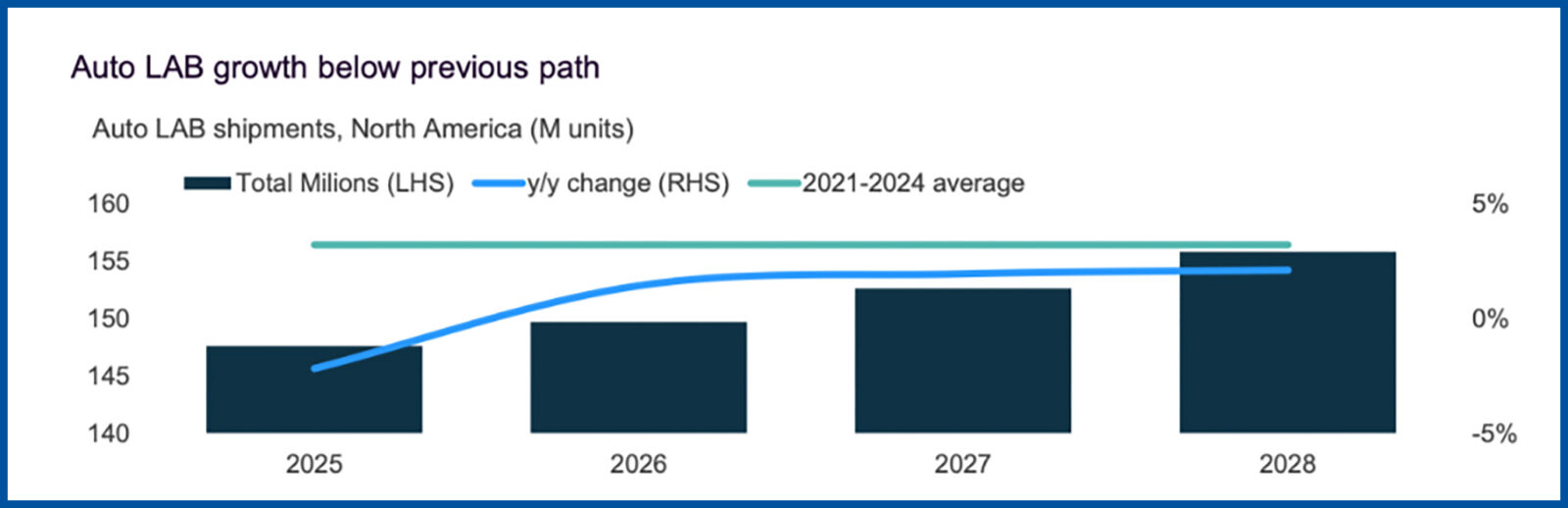
According to BCI data and analysis by commodity research firm CRU, lead battery sales will grow 1.9% in 2026 year-over-year, after contracting 2.1% in 2025. CRU forecasts a 2% annual growth for automotive lead batteries through 2028. This is below the 3.2% yearly average experienced from 2021 to 2024, which was elevated largely due to Covid-era demand.
Beyond lead battery growth, BCI and CRU research also shows the changing automotive fleet of North America – including strong demand for Absorbent Glass Mat (AGM) batteries and other advanced lead battery technologies such as Extended-range Flooded Batteries (EFBs).
Matt Jensen, Director of Consumer & Category Insights at Clarios, presented highlights of the report at the 2026 BCI Convention + Power Mart Expo held May 3 – 6 in Nashville, TN. His overview included the significance of AGM battery demand.
“The automotive market represents two-thirds of the entire [lead battery] market. In North American, six out of every ten vehicles in 2025 model year were AGM batteries,” said Jensen.
Automotive battery demand continues to rely on lead
The report on battery market trends highlights the important role of advanced lead batteries in the North American automotive market. Batteries are essential to U.S. cars and trucks, from starting traditional internal combustion engines (ICE) to supporting critical systems across various electric powertrains.
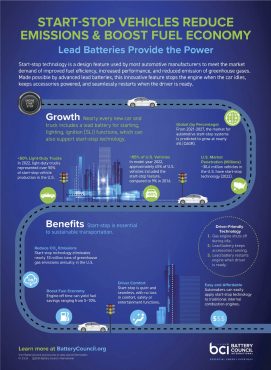
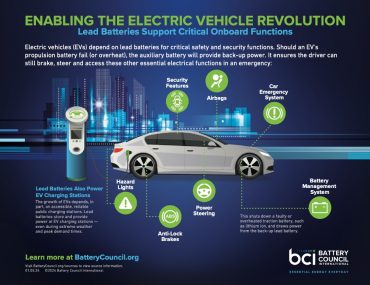
All vehicles across the powertrain range need low 12V batteries to perform auxiliary functions including safety features. That means opportunities exist for lead batteries even in EVs that do not require traditional starter batteries for combustion engines.
The average age of a car in the U.S. was 12.8 years in 2025, according to S&P Global Mobility.
And as the vehicle fleet in North America continue to grow and age, robust battery replacement will continue in addition to demand from new ICE and hybrid vehicle sales. Lead battery replacements totaled around 11 million units in 2025, down 1.6%. However, the long term trend of battery replacement remains strong after 2024 featured the highest growth rate since 2011.
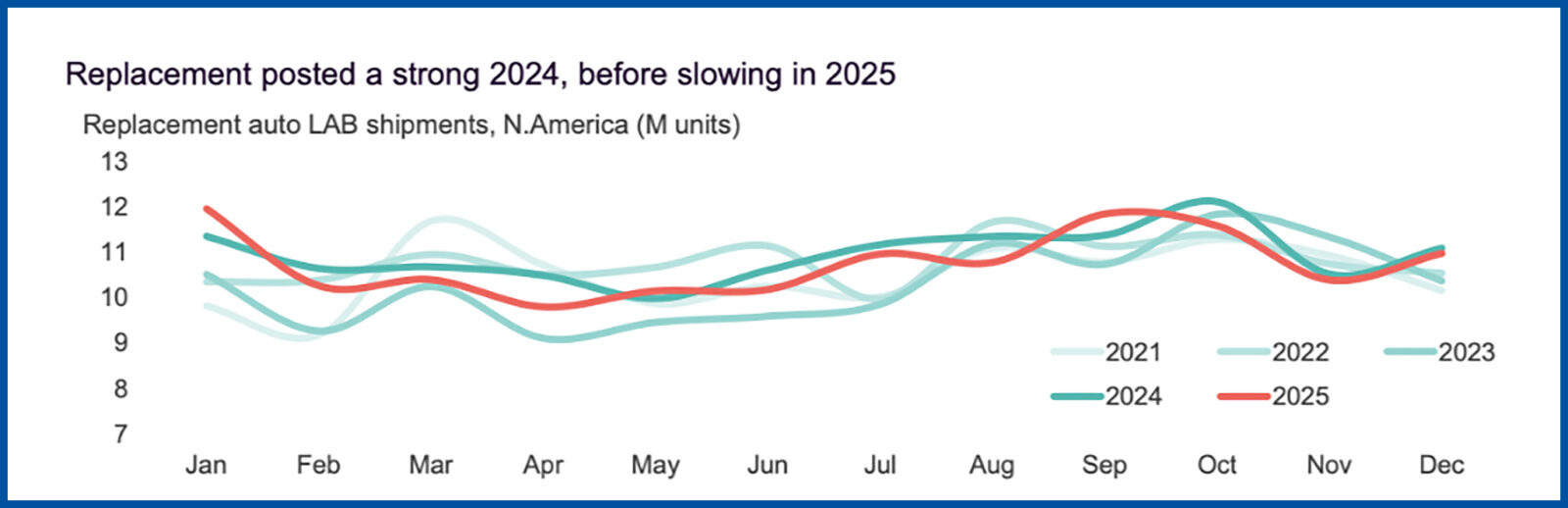
Original equipment (OE) shipments for new vehicles, passenger car and the heavy-duty sectors slowed in 2025 with a drop of 1.7% and 4.2%, respectively. Total OE auto lead battery shipments decreased 3.9% in 2025, totaling around 1.5 million units.
North American BEV market forecast weakens
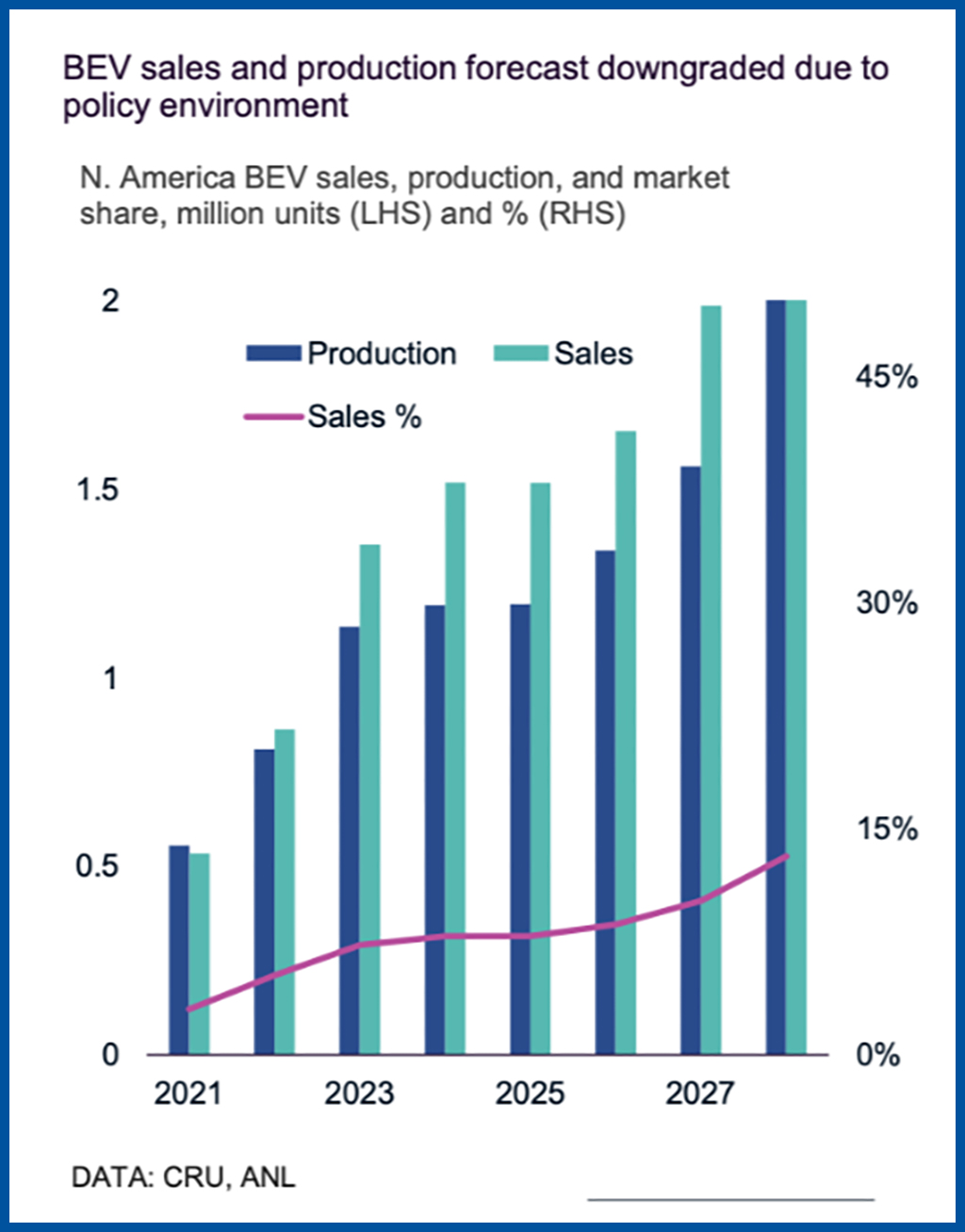
In regards to new sales, battery electric vehicle (BEV) sales grew strongly early in 2025, driven by changes to incentives, new model launches, and emissions compliance. Adoption rates vary and growth is projected to moderate as policy support is withdrawn.
BEV fleet share ticked up only modestly in 2025, hovering around 6%, after North America recorded year-over-year declines in BEV sales on the year. BEV 2026 sales are likely to remain soft after consumer tax credits lapsed in September 2025.
“In the last 12 months, there’s been a big shift by powertrain. If you look out to 2030, we see a drastic reduction in EVs,” Jensen added.
Looking forward, several vehicle manufacturers have announced plans to focus more resources on ICE and hybrid options, and some firms are evaluating alternative uses for excess battery capacity, including battery energy storage.
Lead battery technology shifts to AGM
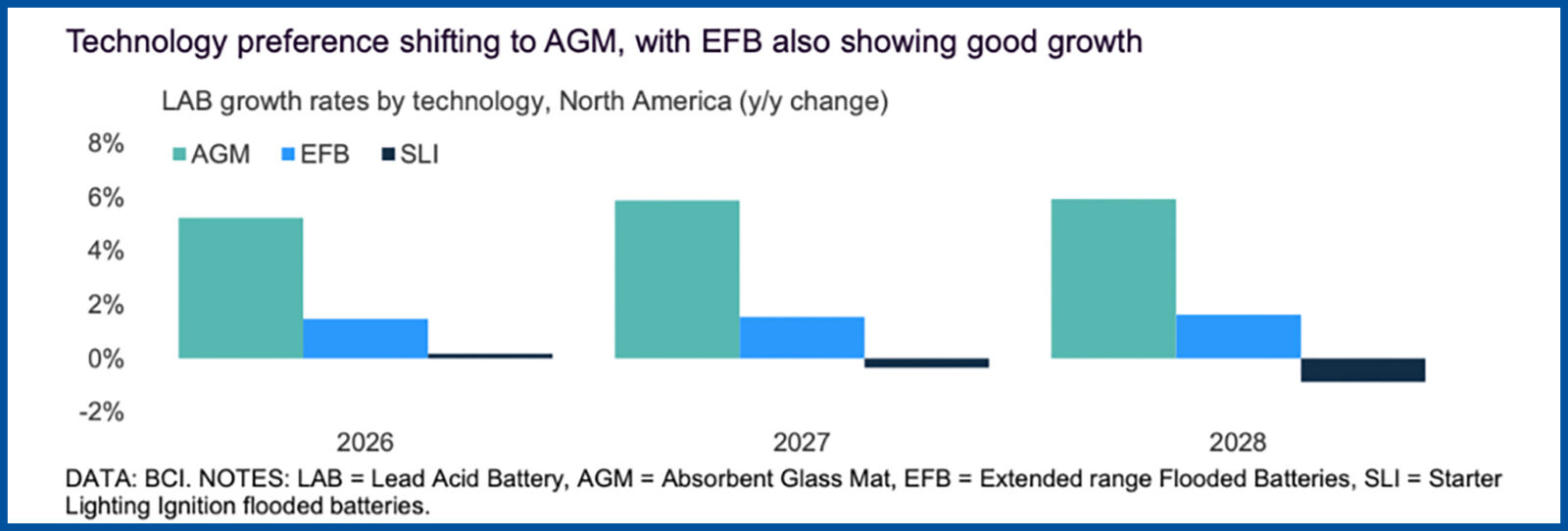
The BCI and CRU report confirms a shift to multi-battery solutions to meet the power needs of vehicles across the powertrain spectrum. Within the automotive lead battery sector, there continues to be strong growth in next-generation products including Absorbent Glass Mat (AGM) and Extended-range Flooded Batteries (EFBs).
As this share grows, Starter, Lighting and Ignition (SLI) batteries are expected to contract from their dominant base.
“AGM really is what’s driving positive growth in the automotive market, growing double digits for the next three years. From a BCI members’ forecast expectation, AGM continues to outperform the other technologies,” Jensen said.
Automotive lead battery forecast: Reserved growth
CRU reports that geopolitical conflicts and other risks have caused great uncertainty for the world economy. As a result, global GDP growth has been downgraded for 2026, with a recovery forecasted in 2027. As a result, CRU modestly downgraded its North American lead battery forecast and warned of a high chance of further downgrades if these global risks persist.
For now, it predicts growth for automotive lead batteries will continue at a modest pace. North American shipments are expected to grow by:
- 1.9% year-over-year in 2026
- 2.0% year-over-year in 2027
- 2.0% year-over-year in 2028
For more information on current data and future projections on the automotive battery market, contact media@batterycouncil.org.