
New BCI-CRU Report Projects 4.5% Annual Demand Growth Through 2028
Battery Council International (BCI) and commodity research firm CRU have released their annual North American industrial lead battery market report, projecting robust sector growth through 2028 with artificial intelligence infrastructure as a primary driver of demand.
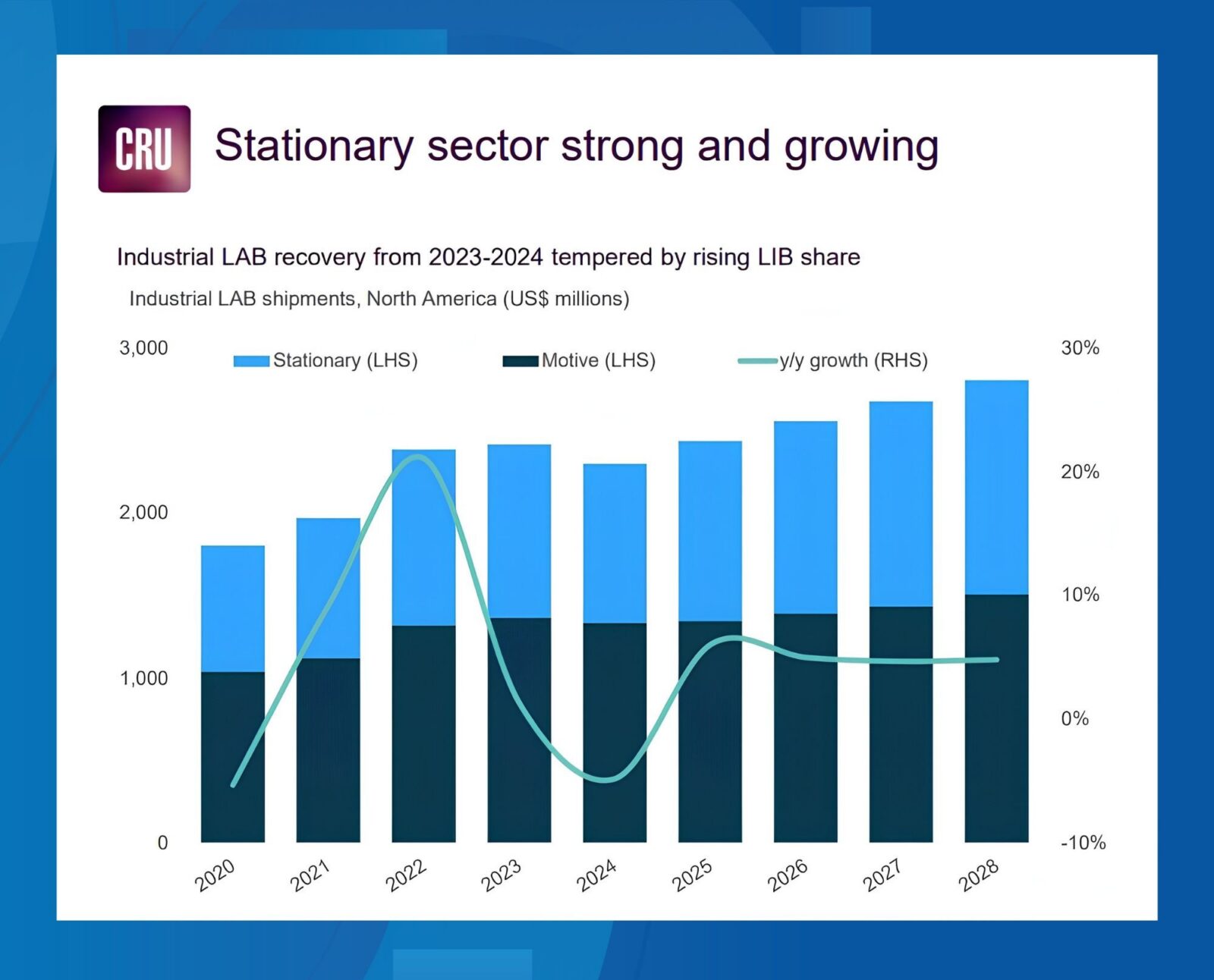
The new report, available exclusively to BCI members, projects a 4.5% compound annual growth rate (CAGR) in industrial lead battery sales across stationary and motive applications.
Resilient industrial lead battery demand
Despite competitive pressure from lithium-ion technologies and the normalization of shipment volumes following pandemic-era demand fluctuations, the North American industrial lead battery market reached $2.44 billion in 2025 — a figure that underscores the sector’s sustained relevance and resilience. Stationary lead battery sales grew 13% overall in 2025, significantly exceeding BCI members’ prior-year forecasts.
Key segments driving this performance include:
- Uninterruptible Power Supply (UPS): Lead batteries remain foundational to data center backup power infrastructure and electricity distribution management. UPS-related lead battery demand surged 21% year-over-year in 2025, with cumulative growth projected to reach 29% through 2028 — a trajectory directly tied to the accelerating buildout of AI and cloud computing facilities.
- Battery Energy Storage Systems (BESS): Lead battery deployment in utility-scale BESS installations is accelerating sharply. Total energy storage capacity in BESS applications is projected to more than double over the next three years, with stand-alone installations such as data centers representing the largest segment of demand.
- Motive Power: The industrial motive sector — encompassing electric forklifts and industrial trucks — is expected to deliver steady, sustained growth, with motive battery shipments projected at a CAGR of nearly 3% between 2025 and 2028.
AI infrastructure drives future growth
The rapid expansion of global data center capacity, fueled by unprecedented capital investment in cloud computing and AI infrastructure, is reshaping electricity demand patterns across the United States — and with them, the battery storage market. Lead batteries play a critical role in this ecosystem, providing the reliability, cost-effectiveness, and high-temperature performance required to maintain continuous AI operations.
Data centers rely on two complementary stationary storage solutions: UPS systems, which deliver immediate short-duration backup power during outages, and BESS installations, which provide longer-duration services including peak shaving and grid frequency regulation.
Together, these technologies enable data centers to scale AI workloads reliably while supporting broader grid stability and energy cost management for surrounding communities.
Supply chain constraints present challenges
While the demand outlook is strongly positive, the report notes that domestic producers have faced difficulties sourcing sufficient critical battery materials to expand production at the pace required to meet BESS demand projections. As a result, imports are expected to remain essential to North American supply chain sufficiency through the forecast period. Policymakers and industry stakeholders will need to consider the implications of this dynamic for domestic manufacturing capacity and energy security.
Supplemental data from the report was presented at BCI’s 2026 Convention and Power Mart Expo in May by Amogh Karwa, Director of Global Product Management, Energy Solutions, at Hollingsworth & Vose. The full report is available to BCI members.
Battery Council International is the leading trade association representing the lead battery industry in North America. The annual market report is compiled using BCI member data, with independent forecasts and analysis provided by CRU, a global commodities research and consulting firm.
For more information, contact media@batterycouncil.org