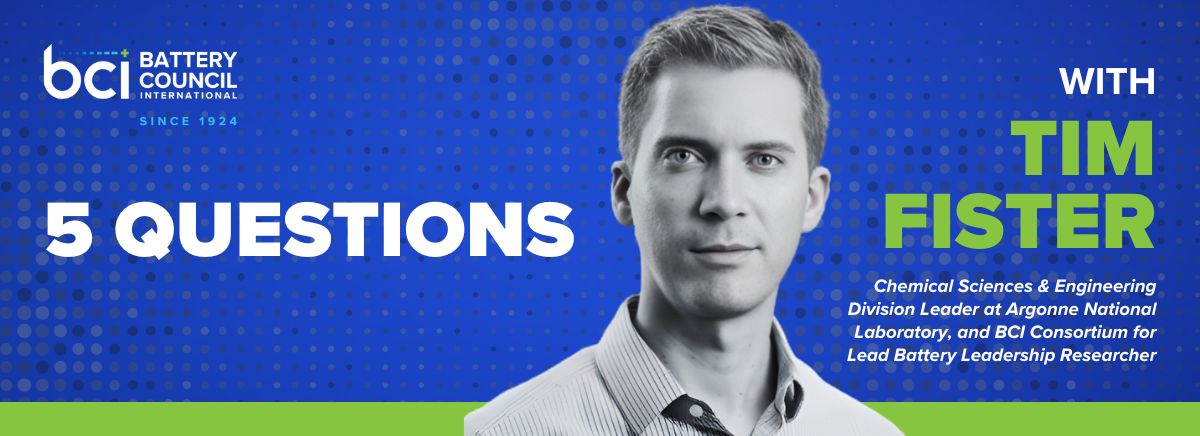
Meet Tim Fister, Argonne leader in the Materials Science Division
Meet Tim Fister, a leader in the Chemical Sciences & Engineering Division at Argonne National Laboratory and an integral part of the Consortium for Lead Battery Leadership.
Led by Battery Council International, the Consortium for Lead Battery Leadership was launched in 2024 and is supported by a $5 million grant from the U.S. Department of Energy. The public-private collaboration includes BCI, leading U.S. battery manufacturers, national labs, and other stakeholders focused on advancing lead battery technology to achieve 10+ hours of storage and reduce costs for end users.

Argonne National Lab is assisting with the consortium’s research, and materials scientist Tim Fister has a key role in guiding the program. His expertise with ANL’s specialized testing equipment makes him an integral part of this project.
Question #1: Much of your battery research involves synchrotron x-ray methods at the Advanced Photon Source. Can you describe both the facility and the process, and why equipment like this at ANL is so important to American growth and innovation?
With its roots in the Manhattan project, national labs provide facilities and capabilities far beyond the scope of your typical R&D lab. APS is a perfect example of this: a multibillion dollar tool providing the brightest source of x-rays in the world and serving thousands of outside users every year. Unlike a tube source, the x-rays at APS result from synchrotron radiation generated by a kilometer of electromagnets that accelerate a beam of electrons to 99.999999% of the speed of light. This provides highly focused x-rays that are a million times more intense than conventional sources at energies that can penetrate working lead acid cells. Walk around the ring at APS and you will begin to appreciate its impact in areas as diverse as protein crystallography for developing pharmaceuticals to materials used in microelectronics and quantum computers!
Question #2: The APS isn’t the only piece of innovative equipment you work on at Argonne. Is it true you helped design, construct and commission the LERIX spectrometer after your PhD? What does that device do, and how is it used?
LERIX was my PhD project under Jerry Seidler and was a great introduction to the synchrotron. Using inelastic x-ray scattering, LERIX is able to measure spectroscopy from low energy electrons (<1 keV) using high energy light (~10 keV). It’s essentially the x-ray analog of electron energy loss spectroscopy (EELS), which is often used in electron microscopy. EELS and “soft” x-ray spectroscopies typically require vacuum conditions, but by using high energy x-ray scattering, you can measure the same spectra from materials that were previously inaccessible—like liquids or samples in a high-pressure cell. With LERIX, we were also able to access quantum states that are normally inaccessible by low energy spectroscopies, in materials ranging from batteries to rare earth elements.
Question #3: As energy storage technology has evolved, so have research methods and tools. What are the new horizons for materials science research? Are there areas that weren’t even possible for study a few decades ago that are now fair game?
The recent upgrade to APS will provide unprecedented focusing and coherence, which will be a game changer for battery research. Coherence—where x-rays waves are effectively in phase, like a laser—can be used to track dynamics and convert complex scattering from discrete crystallites into a real-space picture of particles within a battery. By using diffraction, features related to strain or lattice defects, which are crucial to the performance of lithium and lead batteries, can be easily resolved. AI methods are also revolutionizing the interpretation of data and the design of experiments. This will be crucial for accelerating the development of battery manufacturing and optimization of cycling protocols.
Question #4: What’s it like to work at a U.S. National Laboratory, and how do institutions like Argonne help advance the broader mission of the Department of Energy?
I was fascinated and inspired by the Manhattan Project when I was growing up and it’s been a dream to work in the national labs that continue the tradition of tackling big, mission-oriented problems. While the scope of the labs has broadened considerably since then, the best part of my job is working in large teams from all sorts of backgrounds and seeing battery reactions at APS in action, which echoes the discovery-driven approach of the labs throughout their history.
Question #5: Battery Council International and its members believe strongly in the power of public-private research partnerships to drive real-world innovation. Can you explain the benefits of having representatives from battery manufacturers involved in projects like the Consortium for Lead Battery Leadership?
I’ve always been amazed at how hands-on the lead battery industry is with these types of partnerships. Early on, I relied heavily on collaborators, like Matt Raiford and Subhas Chalasani who tagged along in our first APS experiments, to learn how lead acid batteries work. Over time, these sorts of interactions have worked in the other direction, helping industry understand how synchrotrons and national labs can be useful in their product development. This has resulted in broad engagement with BCI and all members of CLBL, to the point that industry is now leading the design of experiments that we run at APS. At the end of the day, these partnerships also force us to look at data and experiments at a higher level to understand how microscopic mechanisms ultimately affect the macroscopic performance and cost of batteries.